
Metadata
– Slug: designing-resilient-runbooks-operational-documentation
– SEO Title: Designing Resilient Runbooks for Small Technical Teams
– Meta Description: A pragmatic guide for small software engineering teams to design, version, and test operational runbooks using Markdown and Git to eliminate tribal knowledge.
– Canonical Recommendation: https://techsophist.net/designing-resilient-runbooks-operational-documentation/
The Vulnerability of Tribal Knowledge
In small software teams, agility often leads to an over-reliance on tribal knowledge. A single engineer may be the sole custodian of deployments, another of database failover, and a third of API integrations. If an outage occurs when a custodian is unavailable, resolution is delayed.
Unstructured or siloed operational information can be a significant driver of extended Mean Time to Resolution (MTTR). During an active incident, cognitive load is high, and engineers should not have to rely on memory or spend time searching through chat histories to diagnose a production issue. Establishing resilient, standardized runbooks helps ensure that any engineer on the team – regardless of their primary specialization – can validate, troubleshoot, and restore standard operations during a system failure.
Markdown-in-Git: Keeping Runbooks in the Engineering Flow
Many organizations default to hosting their operational documentation on external wikis or document management systems. However, these repositories frequently suffer from “documentation drift” – a state where the documented procedures no longer match the actual systems in production. This occurs because updating the wiki is detached from the software development lifecycle.
A highly practical approach to prevent documentation drift is to treat runbooks like code. By storing runbooks as Markdown files directly within the project’s Git repository (typically in a /docs/runbooks/ directory), teams align documentation updates with code changes.
Advantages of Markdown-in-Git Runbooks
- Integrated Reviews: Runbook updates can be submitted in the same Pull Request (PR) as the code changes, ensuring documentation is peer-reviewed alongside code.
- Version Control Auditability: Teams track changes, dates, and rationale using standard git log and diff tools.
- Portability and Accessibility: If network or DNS outages render external wikis inaccessible, engineers with local clones still possess full access to the documentation.
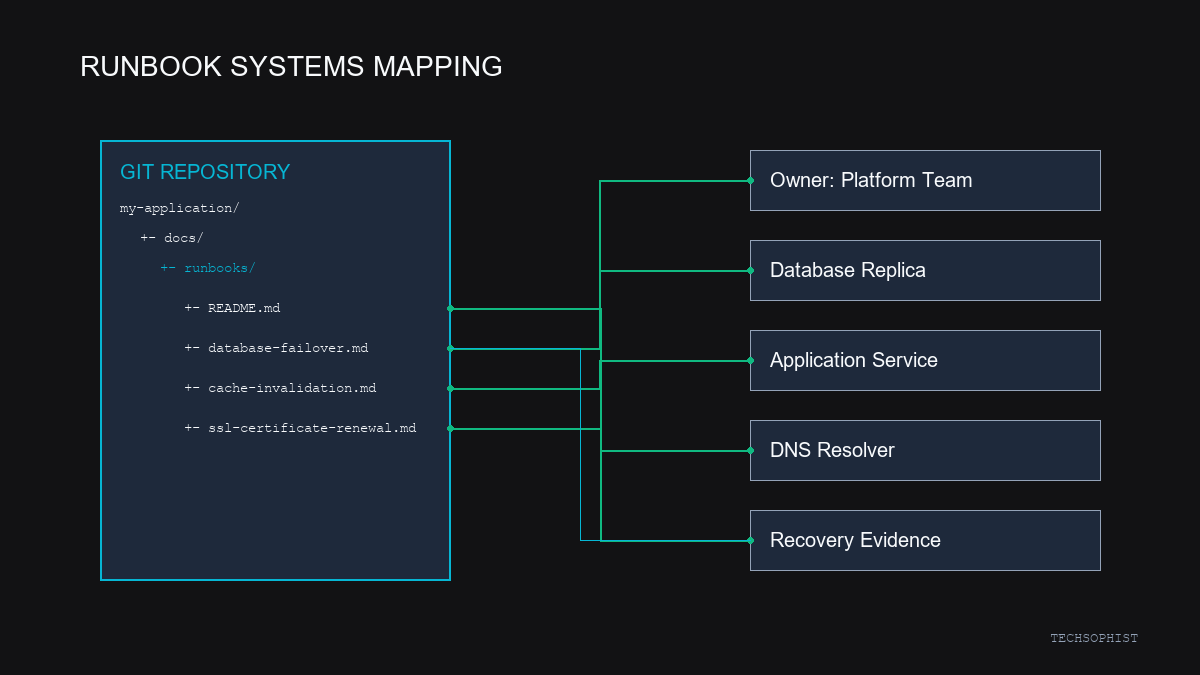
Below is an example of a standard directory structure for an engineering repository containing runbooks:
my-application/
+- src/
+- tests/
+- deploy/
+- docs/
   +- runbooks/
      +- README.md
      +- database-failover.md
      +- cache-invalidation.md
      +- ssl-certificate-renewal.md
The Anatomy of a Production-Grade Runbook
A runbook is a tactical, step-by-step guide to resolving a specific alert. To support engineers under pressure, runbooks should follow a predictable format containing five core elements.
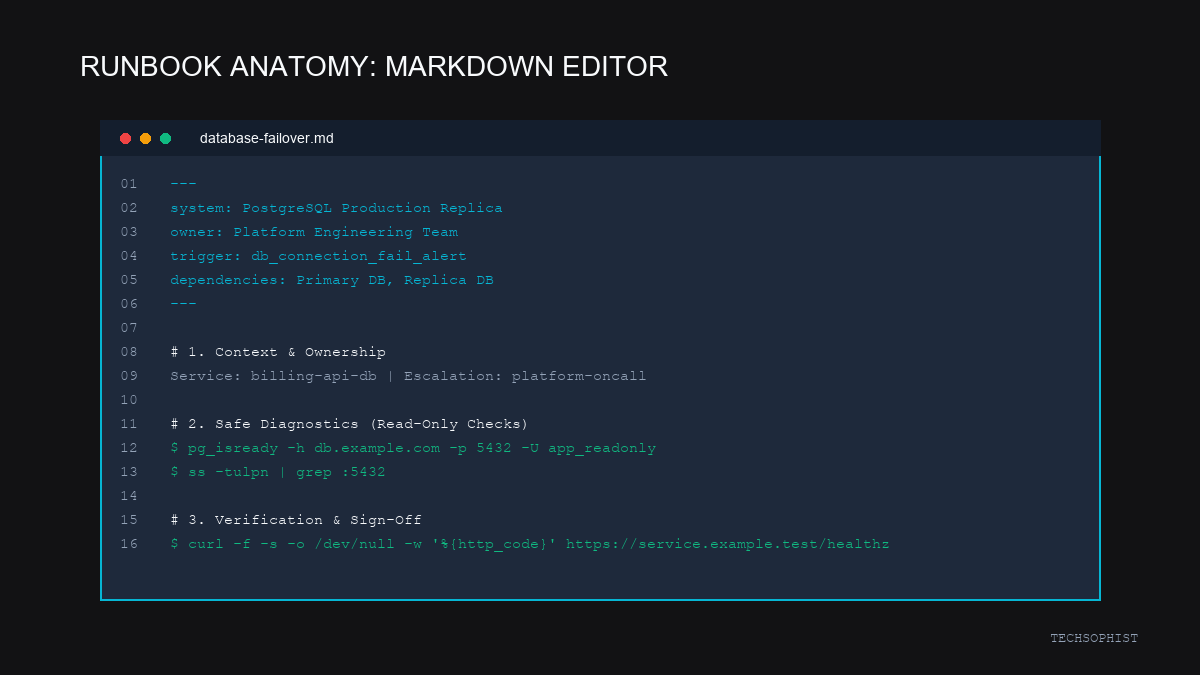
1. Context and Ownership
At the top of the document, clearly define what system or service this runbook covers, who the designated system owner is, and what specific alerts trigger this runbook.
- System Name: Core API Gateway
- Owner: Platform Engineering Team
- Trigger Alert:
HTTP 5xx Error Rate > 2% over 5 minutes - Dependencies: Redis Cache, PostgreSQL Database
2. Quick-Start Diagnostics and Safe Validation
Before executing any destructive or restorative actions, the engineer must confirm the actual state of the system. This section should focus on non-destructive, read-only diagnostic commands to verify the failure mode.
For instance, to verify database connectivity, the runbook should guide the engineer to test the connection using a safe query rather than jumping to service restarts:
# Verify database ping and connection pool status safely
pg_isready -h db.example.com -p 5432 -U app_readonly
3. Separation of Diagnostics and Invasive Remediation
To maintain system stability, runbooks should separate read-only diagnostic checks from invasive remediation procedures. Invasive actions – such as service restarts, cache clearances, or database modifications – carry operational risk and are omitted here. Instead, such procedures belong in a separate, system-specific approved runbook that details rollback steps and is executed by an authorized, accountable operator.
General runbooks should focus on read-only diagnostic commands to assess system health. For example, to check the status of a service and its logs without modifying any state:
# Verify the running status of a system service
systemctl status example-service.service

# Retrieve the final 50 log entries to inspect recent messages
journalctl -u example-service.service -n 50 --no-pager

# Check active network listeners to confirm the service is listening on port 8080
ss -tulpn | grep :8080
4. Escalation Protocols
If the standard diagnostic steps do not resolve the issue, the engineer needs to know who to escalate to. The escalation section should define roles (e.g., Lead Database Administrator, Security Lead) rather than specific names that might change, pointing to the active on-call schedule.
5. Verification and Sign-off
Once diagnostic checks or authorized remediation steps are complete, the runbook should detail how to verify that the system is healthy and ready for traffic. This involves running validation scripts or making test API calls:
# Perform a read-only health check query against the public example endpoint
curl -f -s -o /dev/null -w "%{http_code}" https://service.example.test/healthz
Building and Maintaining the Access Inventory
Incident response is often bottlenecked by locating credentials, access paths, or external contacts. Teams should maintain a secure, updated access inventory.
The access inventory is a centralized catalog of all third-party systems, SaaS dependencies, cloud environments, and domain hosts. To maintain security, the inventory document itself should not contain raw passwords, API keys, or root credentials. Instead, it serves as a map directing authenticated team members to the correct vault location.
| Dependency Type | Provider / Service | Criticality | Owner | Credential Location |
|---|---|---|---|---|
| DNS / Registrar | Cloudflare | Critical | Ops Lead | Vault: Cloudflare Production |
| Cloud Hosting | AWS | Critical | Platform Team | Vault: AWS Root IAM |
| Payment Gateway | Stripe | High | Finance / Dev | Vault: Stripe Production Keys |
| Transactional Email | SendGrid | Medium | Dev Team | Vault: SendGrid API |
Continuous Verification and Review Framework
An outdated runbook can become a liability. If systems evolve but documentation remains static, an operator attempting to troubleshoot an issue may follow incorrect steps, potentially extending system downtime. To mitigate this risk, tech teams should implement a structured review and verification process.
Review and Testing Schedule
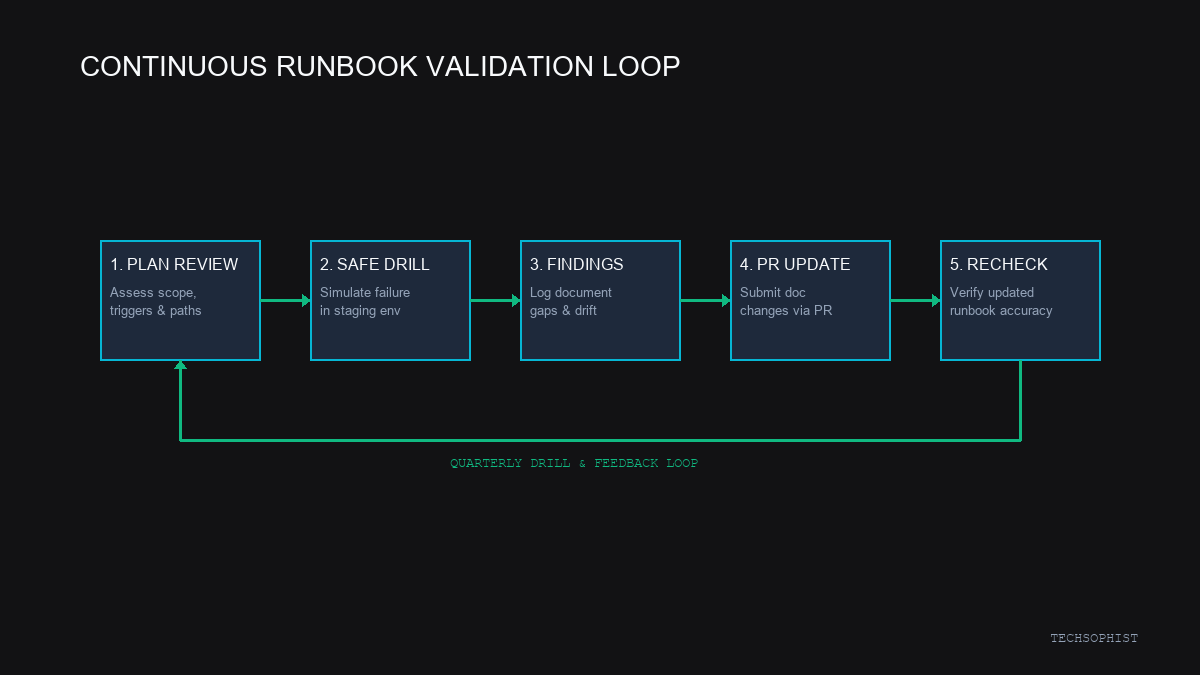
Rather than mandating a single rigid frequency, the schedule for reviewing and testing runbooks depends on system criticality and the rate of material changes to the application or infrastructure. Highly critical systems may require monthly reviews, while stable, low-priority components might be reviewed annually. A quarterly schedule is provided here strictly as a planning example for moderately critical infrastructure.
The Role-Played Disaster Recovery Drill
Using a quarterly cycle as an example, the technical lead may schedule a controlled, simulated recovery drill. During this exercise, a specific failure scenario is introduced in an isolated staging or non-production environment.
An engineer who did not write the runbook is tasked with validating the documentation. The goal of this drill is strictly to test the plan itself – identifying ambiguities, outdated command syntax, or missing dependencies in the document. It is critical to preserve the distinction between testing a plan (which is a scheduled, safe validation of documentation accuracy in a non-production environment) and operating a live production incident (which is an active response to restore service under operational pressure).
Following the drill, any discrepancies found are addressed by submitting documentation updates via a Pull Request.
[!WARNING]
Operational Caveat: Default disaster-recovery drills to isolated staging or testing environments. A production exercise requires an explicit, reversible design, accountable owners, documented rollback, and a controlled risk review.[!IMPORTANT]
Strategic Limitation: A checklist or runbook is a tactical recovery tool, not a substitute for architectural disaster-recovery planning. A resilient system usually needs more than a runbook, including monitoring, backup and recovery design, and suitable redundancy. Runbooks guide human operators when automated recovery systems fail or require manual intervention.
Cited Primary Sources
To ensure the credibility and accuracy of these operational practices, this guide draws upon established methodologies and framework documentation:
- Google Site Reliability Engineering Books:
– Managing Incidents (Chapter 12): sre.google/sre-book/managing-incidents/
– Incident Response (Chapter 9, SRE Workbook): sre.google/workbook/incident-response/ - NIST Information Technology Laboratory:
– Contingency Planning Guide for Federal Information Systems (SP 800-34 Rev. 1): csrc.nist.gov/publications/detail/sp/800-34/rev-1/final - CISA (Cybersecurity and Infrastructure Security Agency):
– Joint Ransomware Guide (Response Checklist): www.cisa.gov/stopransomware/ransomware-guide - Git Documentation Project:
– Official Git Documentation Reference: git-scm.com/doc
0 Comments