
Metadata
– Slug: reducing-client-retention-risks-engineering-handoffs
– SEO Title: Reducing Client Retention Risks Through Secure Handoffs
– Meta Description: Eliminate post-project friction and build long-term client trust with a structured engineering handoff protocol, secure credential transfers, and architecture maps.
– Canonical Recommendation: https://techsophist.net/reducing-client-retention-risks-engineering-handoffs/
The Operational Friction of Product Handovers
In the software services sector, the successful delivery of a custom application represents a major milestone. However, the period immediately following project delivery – when the system transitions from active agency development to client ownership – can be where relationships encounter significant strain. After delivery, system problems can stem from application defects, configuration, operating processes, or unclear handoff responsibilities. A clear handoff does not resolve every issue, but it gives the next operator a usable map of the system and a path for deciding what to do next.
Post-project friction can stem from multiple factors, including codebase quality, system configuration, and the transparency of the handover process. When an agency delivers a system without clear documentation, the client’s internal teams or subsequent service providers struggle to maintain, scale, or troubleshoot the application. While documentation alone is not a guarantee against client churn, offering a structured, transparent handoff package can help support operational continuity and preserve the trust established during the development phase.
Defining the Scope of the Technical Handoff Package
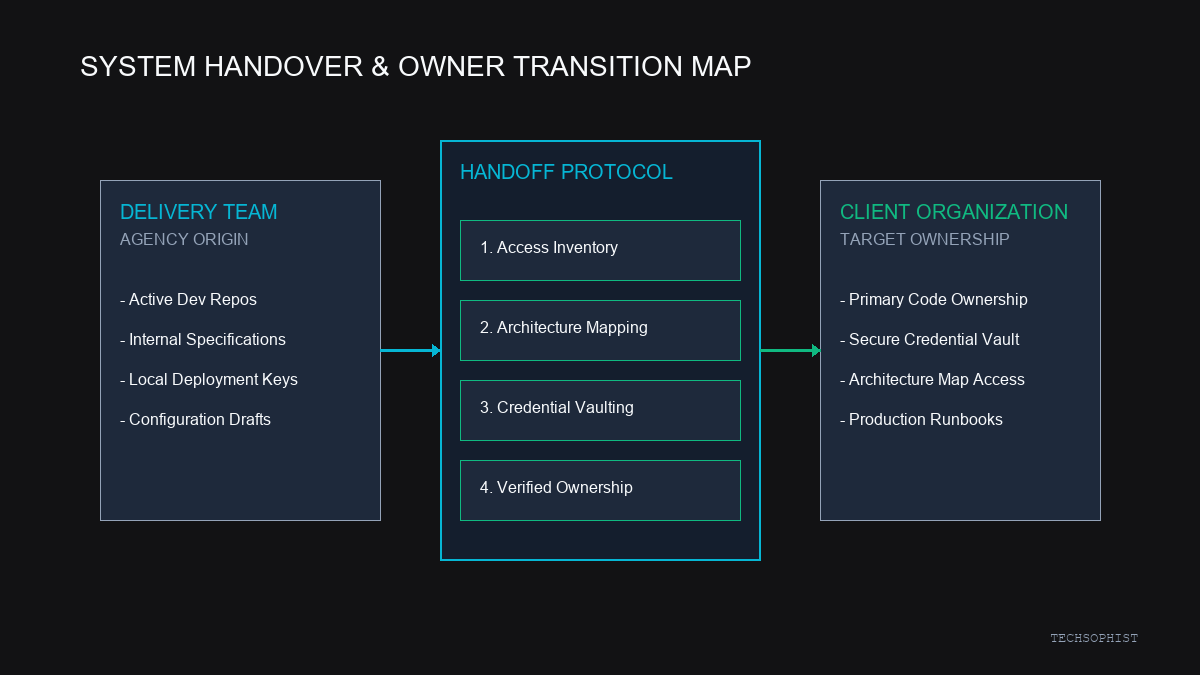
A professional technical handoff is not a single transfer of repository access. It is a structured package of resources designed to give the client full visibility and administrative control over their new technical assets. A complete handoff package often includes four core deliverables:
Handoff Package
+- 1. Codebase Access & Repository Permissions
+- 2. System Architecture & Dependency Mapping
+- 3. Secure Credential Ownership Transfer
+- 4. Client-Facing Operational Runbooks
1. Codebase Access and Repository Management
The agency should confirm that the client has the intended administrative access to the primary source code repositories using the provider’s supported ownership or access-transfer process. This may include organization-level ownership, branch protection rules, and access permissions that let client developers manage the code independently of the agency.
2. System Architecture and Dependency Mapping
A codebase does not exist in isolation. It relies on databases, cache layers, content delivery networks (CDNs), and third-party APIs. The handoff package must include a clear visual or textual map of these dependencies, outlining how data flows through the system and where critical configurations are stored.
The Secure Credential Handoff Protocol
One of the most sensitive phases of a technical transition is the transfer of credentials and API keys. Historically, agencies and clients have shared sensitive credentials through unencrypted channels such as email, instant messaging apps, or plain-text files. This practice exposes both parties to security risks, such as unauthorized access or credential interception, and may conflict with organizational security policies.
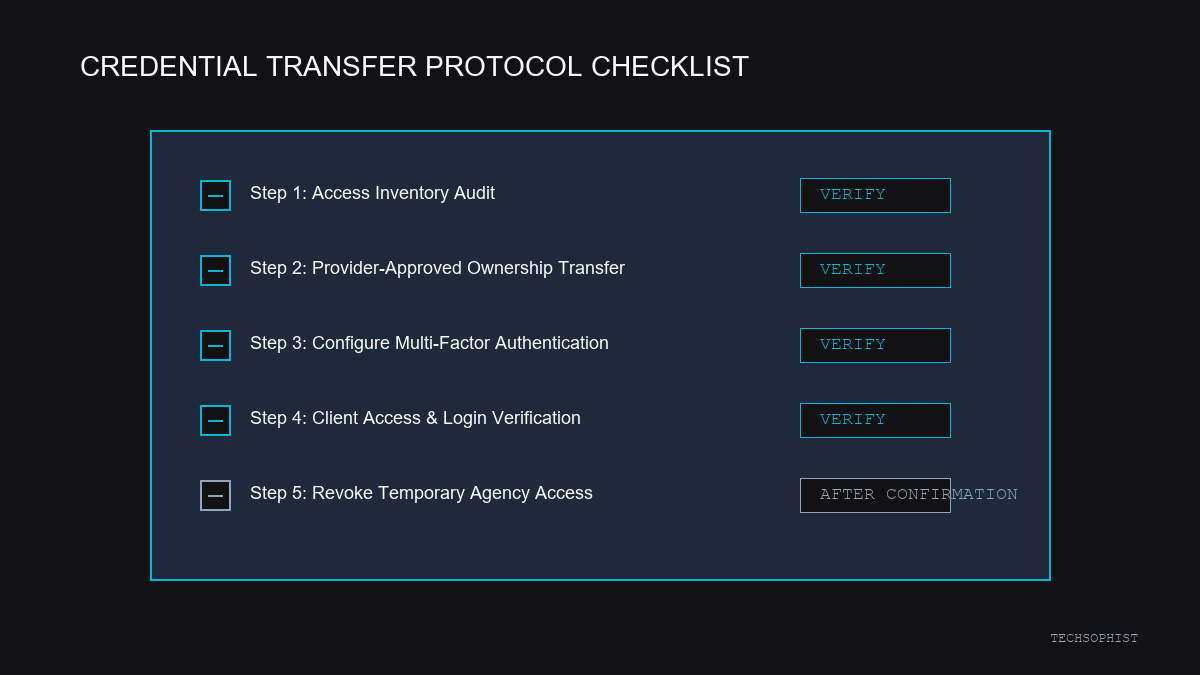
To mitigate these risks, agencies should follow a structured credential handoff protocol:
Step 1: Inventory and Audit
Compile a complete list of all third-party accounts, cloud service consoles, domain registrars, and API integrations associated with the project. Do not list the passwords themselves; list the account names, administrative URLs, and primary owners.
Step 2: Establish Secure Vault Sharing
Instruct the client to set up a corporate-managed password manager or vault (e.g., 1Password, Bitwarden). The agency should then share credentials via a secure, encrypted vault link or shared collection, ensuring that passwords are encrypted in transit and at rest.
Step 3: Transfer Administrative Control
For infrastructure accounts (such as cloud platform organizations or domain registrars), teams should use the provider-supported ownership or administrative transfer path specific to that platform rather than assuming a single provider-agnostic root-email or billing transfer process. This process should verify organization-controlled access, configure multi-factor authentication (MFA) on the new administrative accounts, document rollback procedures and emergency contacts, and ensure that only verified temporary access permissions are subsequently revoked.
Step 4: Revoke Verified Temporary Access and Rotate Secrets
Once the client confirms administrative control, the verified temporary access credentials granted to the agency should be deactivated. To reduce operational risk, the client should rotate production API keys and database credentials to ensure that only current, authorized systems retain access.
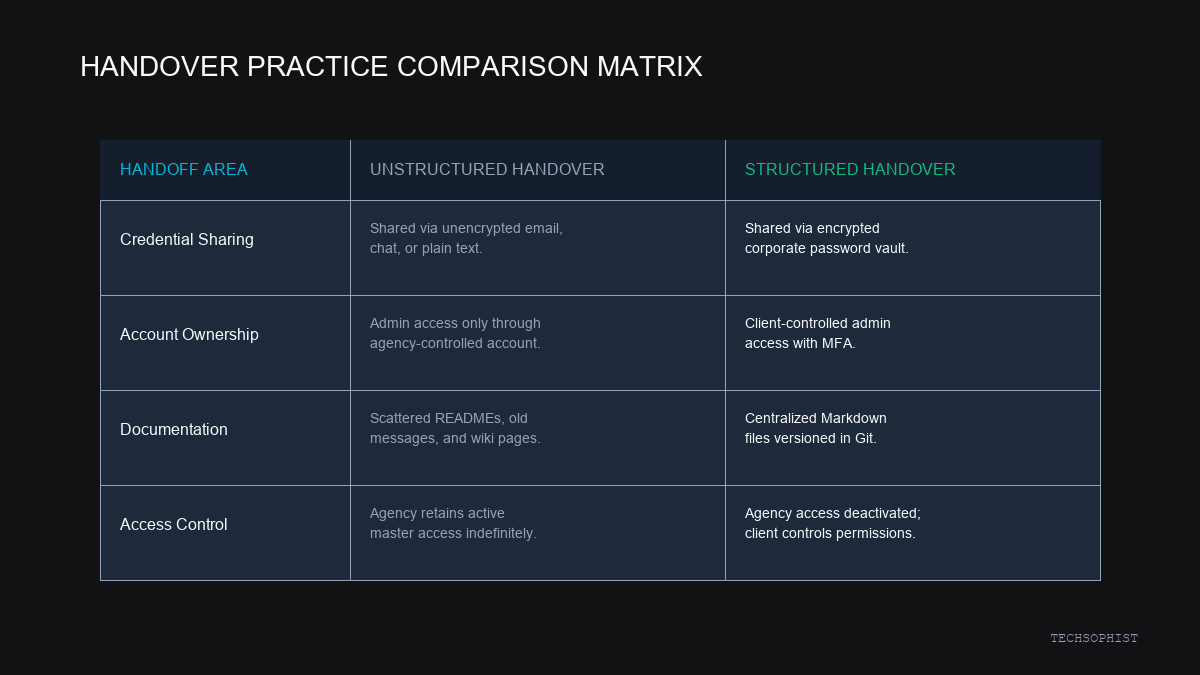
Below is a tabular representation of the differences between standard, chaotic handoffs and structured, secure handovers:
| Handoff Area | Chaotic Handoff (High Risk) | Secure Handoff (Best Practice) |
|---|---|---|
| Credential Sharing | Shared via email, chat, or plain text. | Shared via encrypted password vault. |
| Account Ownership | Administrative access only through an agency-controlled account. | Client-controlled administrative access with MFA. |
| Documentation | Scattered README files and wiki pages. | Centralized Markdown files in the repository. |
| Access Control | Agency retains active master access. | Agency access revoked; client controls permissions. |
Designing the Codebase Architecture Map
A codebase architecture map is a single-page document that explains how the application is structured, how it builds, and how it is deployed. It is written for developers who are new to the codebase, allowing them to understand the system architecture without having to dig through thousands of lines of code.
An effective codebase map should outline:
- System Dependencies: The programming languages, framework versions, and database engines required to run the application (e.g., Node.js v20.x, PostgreSQL v15).
- Build and Deployment Triggers: Step-by-step instructions on how the codebase is compiled and deployed to staging and production environments. For example, explain if a commit to the
mainbranch automatically triggers an AWS CodePipeline run. - Integration Touchpoints: A list of all external API endpoints that the application communicates with (e.g., Stripe, SendGrid, Auth0).
Here is an example template for a codebase architecture map:
# Codebase Architecture Map: Core Billing API

## Technology Stack
- **Runtime:** Node.js v20.11.0 (LTS)
- **Database:** PostgreSQL v15.x
- **Cache:** Redis v7.x
- **Hosting:** AWS ECS (Fargate)

## Build and Deployment
- **CI/CD Provider:** GitHub Actions
- **Pipeline Config:** `.github/workflows/deploy.yml`
- **Staging Deploy:** Automatic on push to `develop` branch
- **Production Deploy:** Manual trigger via release tags (`v*.*.*`)
Reducing Service Friction Through Client-Facing Runbooks
Even after a successful handoff, clients may experience minor operational issues – such as a stuck queue worker, a cached page that needs invalidation, or an expired API key that halts an integration. If the client has no documentation on how to resolve these minor issues, they are forced to contact the agency for emergency support, creating friction and delay.
Agencies can reduce avoidable service friction by providing basic, client-facing runbooks. These are distinct from internal engineering runbooks; they are designed for the client’s internal product managers or IT support staff.
These runbooks should address common, low-risk operational scenarios:
– System Monitoring and Log Inspection: Guidance on where to find system health dashboards and read-only application logs (e.g., in a designated monitoring viewer or console) to check for error codes or connection warnings.
– Viewing Configuration Settings: Procedures for viewing current configuration flags or integration status indicators in a read-only settings panel.
– Support Escalation Procedures: A defined protocol for routing issues, detailing how to open support tickets and contact technical personnel.
Impactful changes, such as modifying environment variables or invalidating production caches, present significant operational risk and must not be performed directly by the reader; instead, these changes must be routed through the approved technical change path.
By documenting these common scenarios, agencies can help empower their clients to handle basic operations, which can reduce response-time frustration and support the agency’s professional relationship with the client.
Cited Primary Sources
To maintain operational integrity and align with industry standards, this handoff framework references established deployment and security guidelines:
- NIST (National Institute of Standards and Technology) SP 800-63B-4:
– Digital Identity Guidelines: Authentication and Authenticator Management.
– URL: pages.nist.gov/800-63-4/sp800-63b.html - CISA (Cybersecurity and Infrastructure Security Agency):
– Require Multifactor Authentication: www.cisa.gov/audiences/small-and-medium-businesses/secure-your-business/require-multifactor-authentication
– StopRansomware Guide: www.cisa.gov/stopransomware/ransomware-guide
0 Comments