

1. Introduction and Scope of Transition
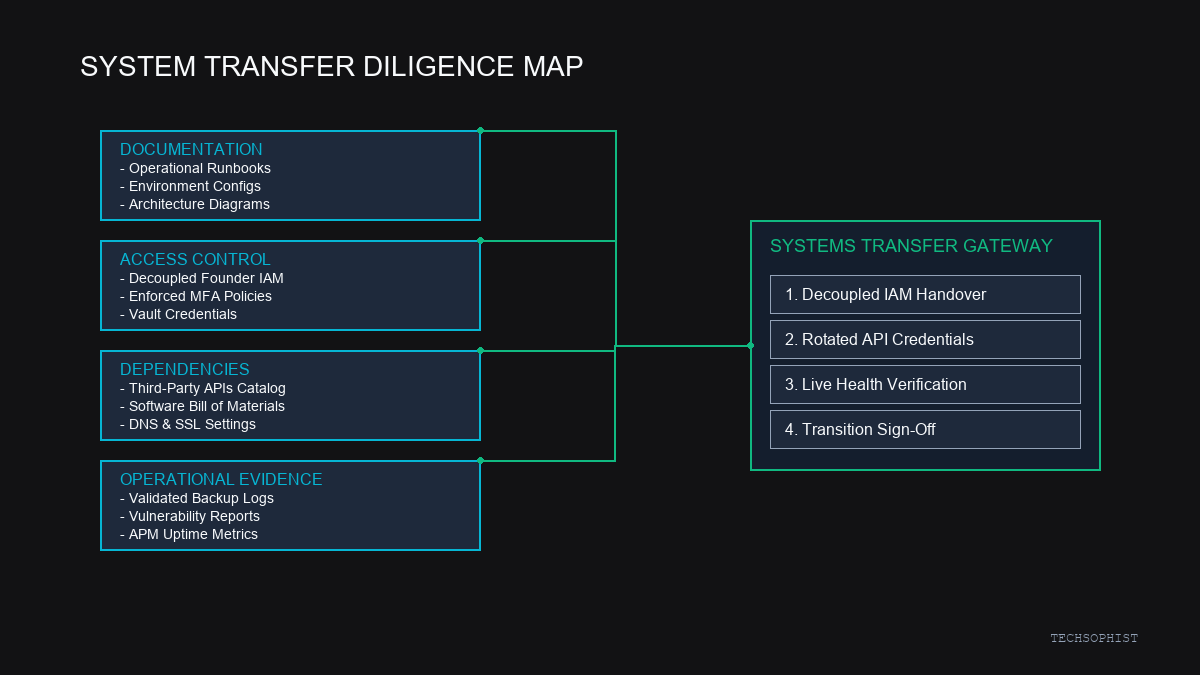
When a software services firm, IT agency, or technology consultancy prepares for a system transfer or corporate transition, the focus typically centers on financial statements and legal agreements. However, the operational reality of the transition depends heavily on the state of the underlying technical infrastructure. A system transfer is a complex migration of codebase repositories, cloud hosting environments, software licenses, domain registries, and operational access controls. Without rigorous preparation, this process can lead to service disruptions, security vulnerabilities, and operational bottlenecks.
This guide serves as an independent technical-operations resource for service firms preparing systems, access, documentation, and operational evidence before a transfer or transition. It is structured to help engineering teams and leadership review their operational posture before moving responsibility to a new owner or operating team.
Disclaimer: This document is for informational and educational purposes only. It does not constitute legal, tax, securities, investment, or mergers and acquisitions (M&A) advice.
2. Infrastructure Inventory and Dependency Mapping
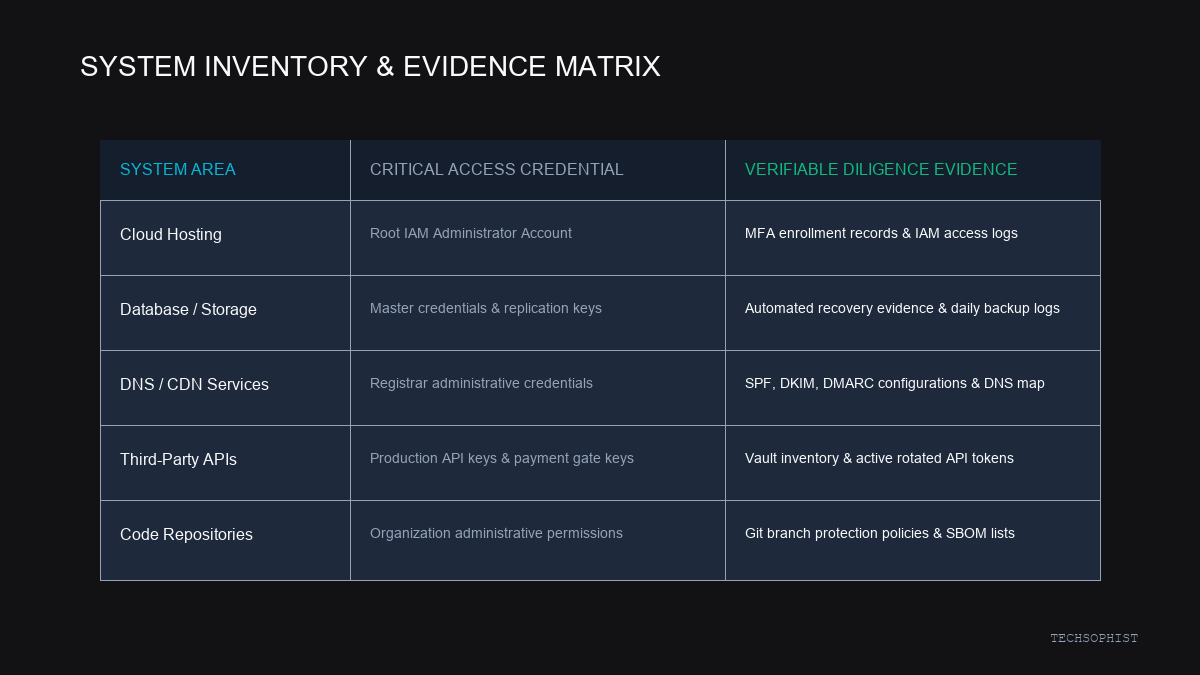
The first phase of technical operations diligence is compiling a comprehensive registry of all digital assets and infrastructure dependencies. In many boutique agencies, systems are added ad-hoc as projects scale, resulting in undocumented integrations. A complete systems transfer requires a clear mapping of these components to prevent critical failures during the transition.
Cataloging Cloud Environments and Hosting Services
Firms must document all production, staging, and development environments. This inventory should detail the cloud provider (e.g., Amazon Web Services, Google Cloud Platform, Microsoft Azure), the primary region of deployment, and the resources provisioned (e.g., virtual machines, managed databases, serverless functions). Each resource must be linked to its purpose and its corresponding source code repository.
Identifying Third-Party APIs and SaaS Dependencies
Modern software systems rely on a network of external integrations, including payment gateways, transactional email services, search APIs, and analytics packages. Diligence requires listing every external service, the associated API keys, and their current billing ownership. Undocumented dependencies can result in unexpected service cut-offs if a parent account is deactivated or modified during the transfer.
Mapping Network Architecture and DNS Settings
DNS registries and domain portfolios are critical assets that require careful handling. Teams must document:
- All active domain names and their registrars.
- Name server configurations and CDN endpoints (e.g., Cloudflare, Akamai).
- A complete map of DNS records, including A, CNAME, MX, and TXT (SPF, DKIM, DMARC) entries.
- SSL/TLS certificate management practices, noting renewal mechanisms and expiration schedules.
3. Access Governance and Administrative Decoupling
A primary source of friction during system transfers is the intermingling of personal and organizational credentials. In many founder-led service firms, critical systems are registered under personal email addresses or hosted on private accounts. Decoupling these accounts is a critical security and operational requirement before any transfer.
Decoupling Founder and Personal Accounts
All administrative access to hosting platforms, code repositories, and third-party services must be moved to organizational identities. A common failure mode is a domain registrar or cloud service console that is registered to the personal email of a former employee or founder. Correcting these configurations prevents lockouts and ensures that ownership can be cleanly reassigned.
Enforcing Least Privilege and Multi-Factor Authentication
In line with CISA identity and access management guidance, firms should review and restrict access permissions before a transfer. The review should confirm that administrative privileges are assigned only where they are necessary and that the incoming operating team can establish its own controlled access. Multi-factor authentication should be enabled for administrative consoles, with the chosen method documented in the handoff record.
Transitioning to Enterprise Credential Vaults
Raw passwords, private ssh keys, and API tokens must never be stored in plain text or shared via insecure channels. Operational diligence requires that all shared credentials be centralized in an enterprise password manager (e.g., 1Password, Bitwarden). This enables the clean sharing of encrypted vault items with the incoming team, followed by the immediate revocation of legacy access.
4. Codified Documentation and Version-Controlled Runbooks
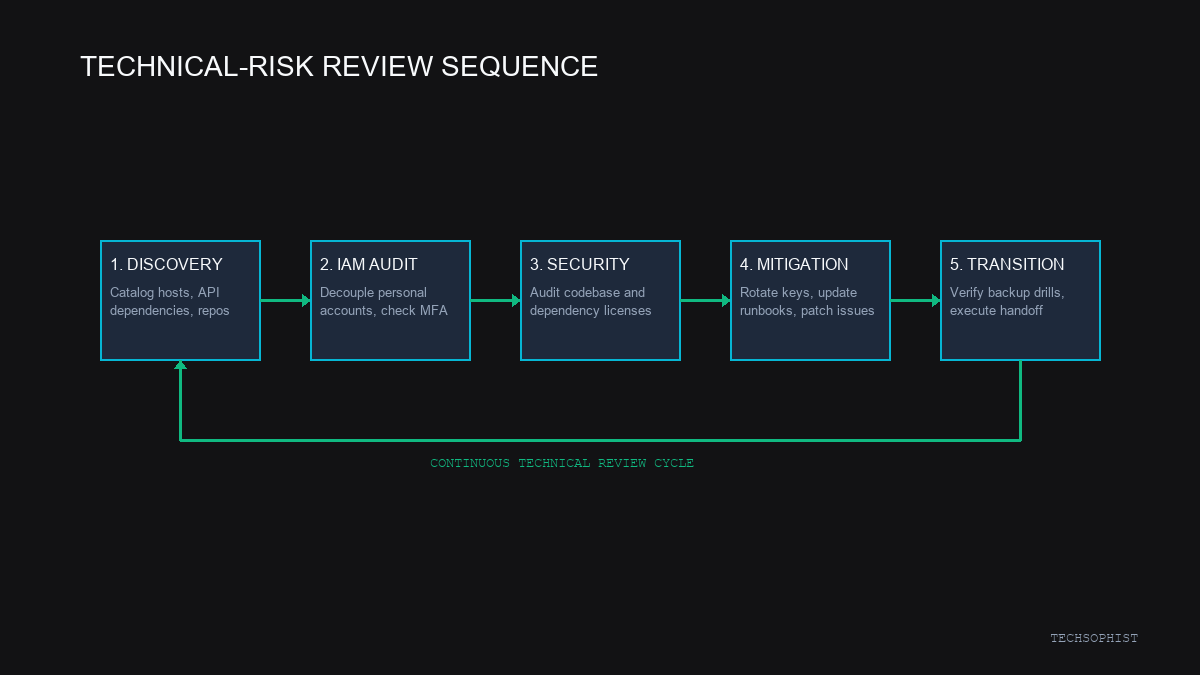
Documentation is the bridge that allows an incoming team to operate a system post-transfer. When documentation is missing or outdated, the transition is stalled by a constant exchange of questions and troubleshooting requests. To achieve operational readiness, service firms must provide structured, version-controlled documentation.
Markdown-in-Git for Operational Transparency
Hosting documentation in a separate wiki often leads to documentation drift, where the instructions fail to match the production state. To maintain accuracy, operational documentation should be treated like code. Storing documentation as Markdown files directly within the code repository (e.g., in a /docs/ folder) ensures that any architectural changes are submitted and reviewed alongside code changes.
The Necessity of Tested Runbooks
A runbook is a tactical guide designed to assist an operator in resolving specific system failure modes. When transitioning systems, teams should establish version-controlled, tested operational procedures, as outlined in our guide on designing resilient runbooks. These runbooks must include:
- System properties, ownership details, and dependency declarations.
- Non-destructive diagnostic commands to verify the system state.
- Step-by-step restoration paths for common issues (e.g., database restarts, cache clearing).
- Clear escalation procedures and verification checks.
Compliance with Continuity Standards
Firms can use authoritative contingency-planning guidance, such as NIST Special Publication 800-34 Rev. 1, to frame recovery documentation. Documented system boundaries and recovery steps give the incoming team a clearer basis for operating the systems after the handoff.
5. Dependency Management and Licensing Compliance
A system transfer is not merely a transfer of files; it is a transfer of software assets that must comply with licensing and security standards. Unresolved dependencies and license conflicts can expose the incoming team to legal and operational liabilities.
Auditing Open-Source Software (OSS) Licenses
Firms must audit all open-source libraries, frameworks, and packages used in the codebase. This involves generating a Software Bill of Materials (SBOM) to catalog all direct and transitive dependencies. The audit must verify that all software licenses (e.g., MIT, Apache 2.0, GPL) are compatible with the target deployment model.
Managing Version Pinning and Security Vulnerabilities
Outdated dependencies present both a security risk and an operational challenge. Diligence requires verifying that:
- Dependencies are pinned to specific, stable versions to prevent breakages during builds.
- Automated dependency scanning tools (e.g., Dependabot, Snyk) are active.
- Known security vulnerabilities are patched or mitigated.
- System dependencies (such as runtime versions, database versions, and OS libraries) are documented and standardized.
6. Operational Evidence and Transition Verification
Documenting a system is only half of the diligence process; the transition record should also identify the evidence available for core controls and operating procedures. This evidence helps the incoming team assess what has been documented, tested, and still needs attention.
Verifying Backup Integrity and Recovery Times
Having a backup policy is insufficient; firms must prove that backups are actively created, encrypted, and restorable. Diligence evidence should include:
- Automated backup schedules for databases, file storage, and configurations.
- Recent restore-test records and any documented recovery objectives.
- Off-site and multi-region replication confirmations.
Collecting Security and Monitoring Telemetry
To verify system health and security compliance, the firm should compile:
- Recent vulnerability scan reports for the codebase and infrastructure.
- Application performance monitoring (APM) metrics showing uptime and error rates.
- Audit logs tracking administrative access changes.
- Configuration-review records informed by relevant controls in NIST Special Publication 800-53 Rev. 5.
7. Structured Transition Protocols and Handoffs
Once the diligence phase is complete, the physical transfer of systems must follow a structured, step-by-step protocol. Ad-hoc transfers often lead to configuration drift or temporary outages that can harm client relationships.
Setting Clear Architecture Boundaries
Before beginning the physical transfer, both the outgoing and incoming teams must align on the boundary lines of the system. This involves detailing exactly which repositories, databases, and third-party integrations are included in the transfer, and which are excluded or deprecated. Assisting firms in reducing client retention risks through structured engineering handoffs helps ensure that client-facing services remain stable during the backend migration.
The Dual-Run Period and Final Sign-Off
Where access governance and the handoff plan permit it, a defined overlap period can give the incoming team time to validate systems while outgoing personnel retain only the access needed to support the transition. A formal sign-off checklist should verify that the incoming team has:
- Assumed primary ownership of all repositories and domains.
- Updated administrative contact details and billing info.
- Rotated all production API keys, database credentials, and SSL certificates.
- Enabled independent MFA on all transferred consoles.
- Successfully verified system operations in the new environment.
8. Operational Preparation and Technical Valuation Factors
Beyond the immediate mechanics of the migration, the state of a firm’s technical operations reflects its overall maturity and governance. When a service firm prepares its systems for a transfer, the depth of its documentation, the clarity of its access governance, and the stability of its infrastructure are critical indicators of operational health.
While compiling this technical-operational evidence is primarily a systems-governance requirement, it can also serve as one input to a broader discussion of industry valuation factors for technology firms. A firm that can present structured, version-controlled runbooks, clean IAM configurations, and automated backup evidence demonstrates that its services are built on repeatable, transferrable systems rather than key-person dependencies. Conversely, a firm with undocumented systems and chaotic access controls presents a higher risk profile, requiring substantial remediation efforts from the incoming team to ensure system stability.
By treating technical operations diligence as a core preparation step, service firms protect their operational integrity, simplify the migration process, and ensure that their systems are prepared for long-term operational success under new ownership.
Authoritative Sources
National Institute of Standards and Technology
- Contingency Planning Guide for Federal Information Systems (Special Publication 800-34 Rev. 1): csrc.nist.gov/pubs/sp/800/34/r1/final
- Security and Privacy Controls for Information Systems and Organizations (Special Publication 800-53 Rev. 5): csrc.nist.gov/pubs/sp/800/53/r5/upd1/final
Cybersecurity and Infrastructure Security Agency
- Identity and Access Management Best Practices: www.cisa.gov/resources-tools/resources/identity-and-access-management-best-practices-guide
- Cross-Sector Cybersecurity Performance Goals: www.cisa.gov/cross-sector-cybersecurity-performance-goals
Google Site Reliability Engineering
- SRE Book chapter: Managing Incidents: sre.google/sre-book/managing-incidents/
0 Comments